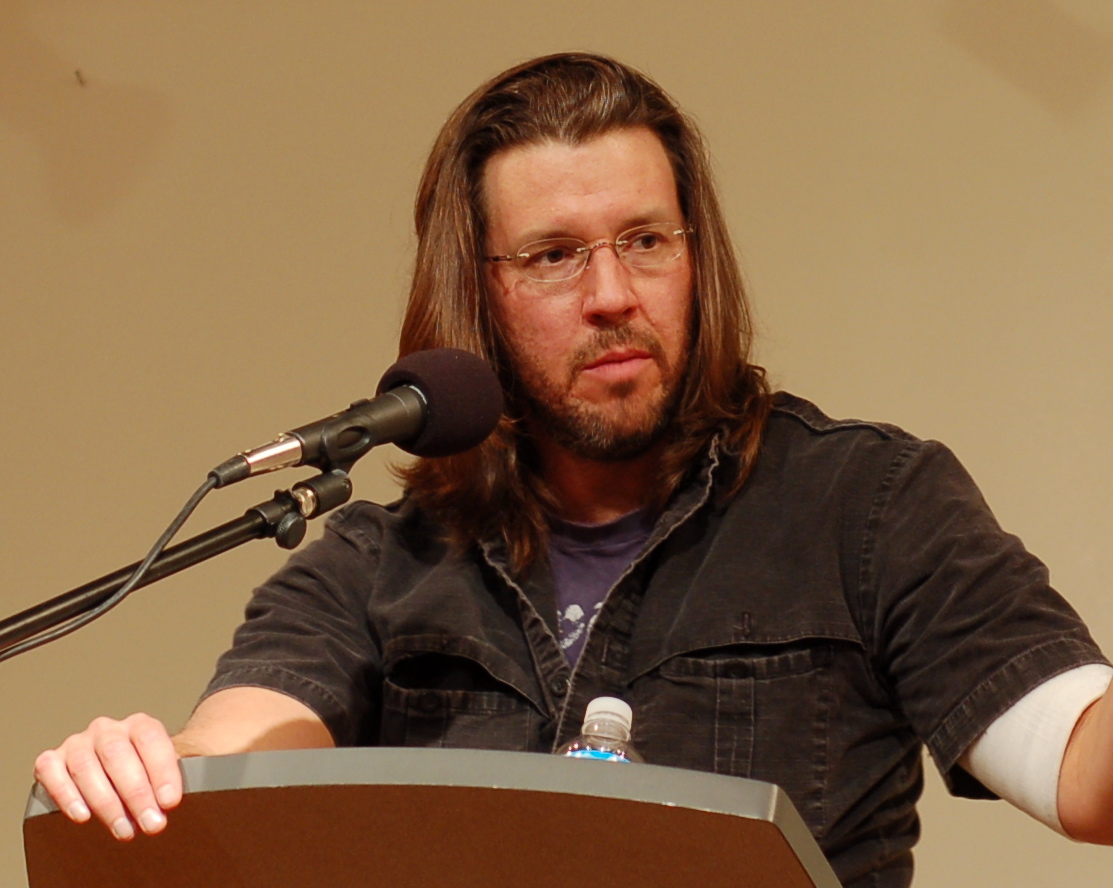
David Foster Wallace’s essay, “E Unibus Pluram” is written
in reaction to and position with postmodernism, and, more specifically,
postmodern irony. In it Wallace
says of irony that it is much like a “Third World rebel” coup in that, “Third
World rebels are great at exposing and overthrowing corrupt hypocritical
regimes, but they seem noticeably less great at the mundane, non-negative task
of then establishing a superior governing alternative” (67). Irony is great at deconstruction, but
it doesn’t insert anything of positive value, nothing additive, in place of
what it deposes, debunks, takes apart, or ridicules. He goes on to say, “Make no mistake: irony tyrannizes us”
(67). He is saying that we cannot
escape irony. If this is indeed
the case, that would mean that everything has two meanings, the literal and the
ironic, which is the equal opposite of the literal. One can see how this might be depressing after a while as we
would never have a real idea of what to consider real or authentic.
*
It’s worth talking about the fact that many scholars try to
either align Wallace with postmodernism or, alternatively, try to separate him
from postmodernism. Part of this section is to point out that I am joining a
conversation already in progress as well as to point out that there is a
general consensus that there needs to be something after postmodernism, which
then helps to bolster the claim that Wallace’s “E Unibus Pluram” can be seen as
a manifesto for this next iteration.
To start with, Wallace scholar Paul Giles says of
postmodernism in his essay, “Sentimental Posthumanism: David Foster Wallace”
that “Postmodernism, of course, tended ideologically to reverse the premises of
this authoritarian distinction between center and margin, valorizing the latter
at the expense o the former” (327).
It is Giles’s contention that postmodernism is about the rural, the
edges of the city, which aligns nicely with Frederic Jameson’s assertions.
Giles goes on to say that Wallace “tends to flatten this distinction entirely”
(327), the distinction being between the center and the margin, or high and low
culture as it so often tends to play out.
Giles time and again works to separate Wallace from postmodernism, “Many
of Wallace’s stories take issue explicitly with the reflexive dimensions of
postmodernism” (331). Giles goes on to suggest that Wallace’s work fits much
better in the “posthuman” mode of thinking, which I agree with, but only to an
extent – “Posthuman” is a box that Giles seems to be forcing Wallace into, much
the same way he is often forced into postmodernism, even though some of his
parts don’t fit. So he is forced
to rely on works like Infinite Jest and
the short story “Good Ol’ Neon”, which fit nicely, while ignoring pieces like
“E Unibus Pluram”, which doesn’t.
Also, it is entirely possible to perform a posthuman reading of much of
what Wallace wrote (as well as hundreds of other writers and creators), but
that does not mean that Wallace was a ‘posthumanist’. All in all though I am a big fan of this essay and agree
that Wallace should be thought of as doing something that is not normally
associated with postmodernism, and to lump him in with that mode of thought
usually comes out of not knowing what else to do with him.
Robert L. McLaughlin adds another wrinkle to the
conversation. To start with he
positions postmodernism as, “skepticism toward narrative as a meaning-providing
structure” which then operates to make “opaque the process of representation”
(59). The suggestion here seeming
to be that postmodernism often avers for form over content. He then goes on to say that Wallace
(among others) “implies a critique of postmodernism” (59), which, of course, I
agree with. McLaughlin ends by
referring to Wallace as being part of “post-postmodernism” (66), which might
sound like a rather lazy place holder for anything better, but makes sense as
he concludes his argument by suggesting that Wallace et. al. are still a part
of postmodernism and that their views on the subject were nothing more than a
“matter of emphasis” (66). So,
rather than find a way to place Wallace in a new vein, McLaughlin just shoves
him back into the postmodern box.
Ultimately this leaves me feeling unsatisfied, probably because I am a
huge Wallace fan, which I readily admit to, but also because the term
‘post-postmodernism’ again creates a need to always connect what Wallace does
to postmodernism in much the same way postmodernism is always attached to
modernism. The argument becomes
recursive, which itself feels postmodern and isn’t that what we’re trying to
escape?
*
Lee Konstantinou is doing some pretty interesting work on
Wallace and the next iteration of thinking. He is working on a Ph.D. dissertation for Stanford which is
as of yet unfinished, but worth looking at briefly nonetheless. He intimates that “Wallace uses
metafictional form to cultivate reader belief and to short-circuit what he sees
as the irony characteristic of American consumer culture” (1). Much like this blog, Konstantinou has
keyed in on Wallace’s concern with irony and, as a matter of fact, has gone so
far as to put forth a name for the next generation of thought, which he says
Wallace is the forerunner or progenitor of. He dubs this next iteration “post-irony” (1). I like this, but I doubt it will catch
on (not that radical literalism will catch on!) I think the problem lies with having to then prove that
there was (or is) a form of literary or philosophical thought called “irony”
that in turn spawned a spate of artistic endeavors. I suppose the case could be made though; in writing this
essay I found plenty of work on this from Albert Camus’s essay “Irony” from his
book Lyrical and Critical Essays, to
Giles Deleuze’s discussion of irony in The Logic of Sense. The
task is Herculean though.
I suppose that personally I don’t really like referring to
what Wallace was doing as post-irony in that the label then directly links him
with irony and serves to operate much like the term non-fiction, which defines
the genre only by what it isn’t, but in this case by what it doesn’t want to be
or is leery of.